Web Designer vs Web Developer: How to Hire the Right Professional for Your Website
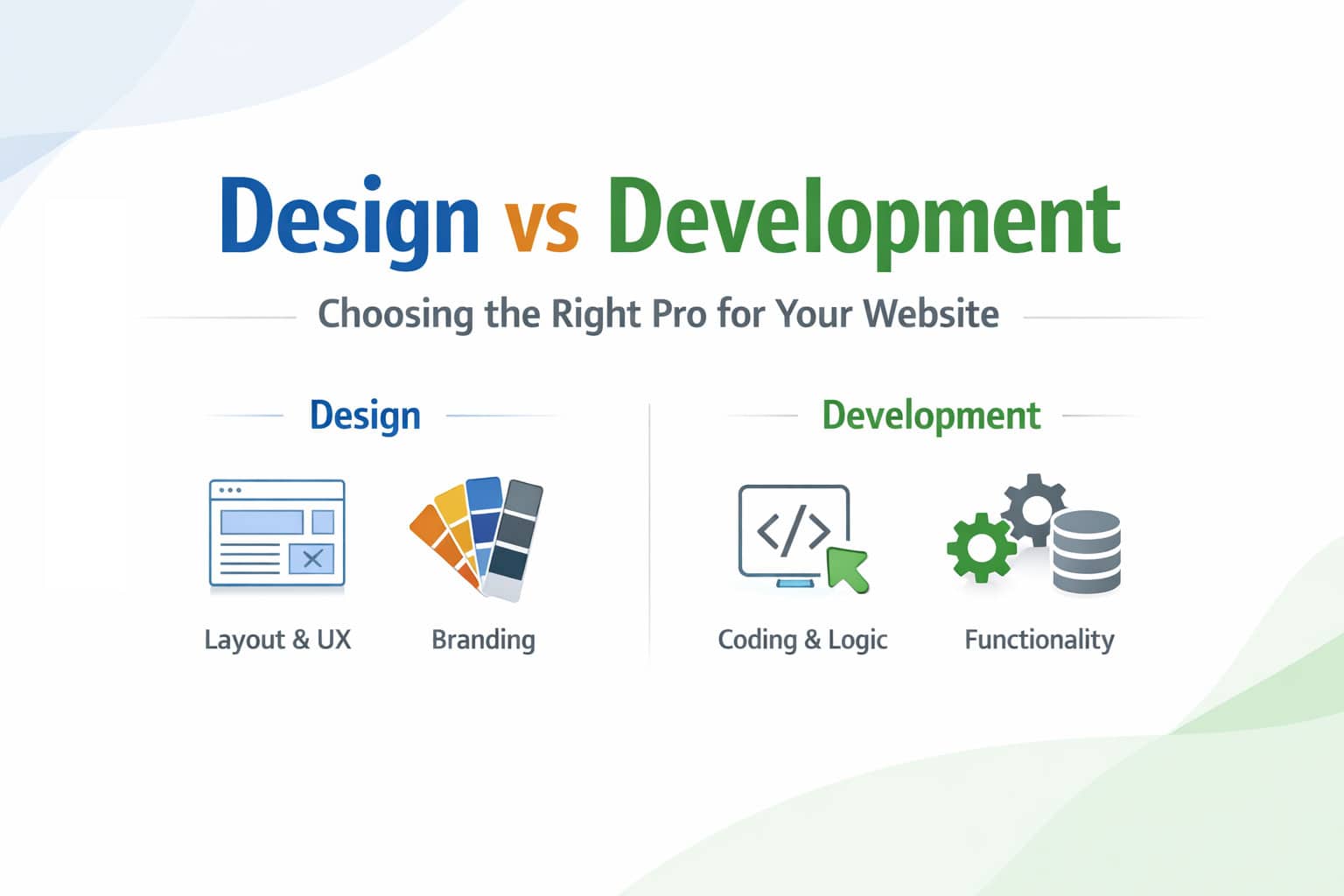
The difference between a Web Designer and a Web Developer is this: a web designer focuses on how a website looks, feels, and communicates, including layout, usability, branding, and user experience, while a web developer focuses on how a website functions behind the scenes, including writing code and building custom functionality, integrations, and systems.
In many cases, especially for marketing and informational websites, strong design and strategy are far more important than custom development, which should only be used when a site truly requires complex or proprietary functionality.
One of the most common (and expensive) mistakes business owners make is hiring the wrong type of web professional for the job.
Not because they’re careless, but because the terminology around websites is confusing, and “more technical” often sounds better.
As a web designer and SEO expert, I regularly work with businesses whose websites were custom-developed, when a simple design would have been more than sufficient. The result is usually the same: a rigid website that’s hard to update, difficult to optimize, and expensive to evolve.
The Real Difference: What Your Website Needs to Do
Before deciding whether you need a web designer or a web developer, the most important question is this:
Is your website a marketing asset or a software product?
Most business websites are marketing assets.
Very few are software products.
What a Web Designer Actually Does
A web designer focuses on clarity, usability, and presentation. Their job is to make sure your website:
- Communicates your value clearly
- Looks professional and trustworthy
- Guides visitors toward action
- Works well on all devices
- Can evolve as your business grows
Modern web designers often work within platforms like WordPress, Webflow, or Shopify and use existing frameworks, themes, and plugins strategically.
For most small and mid-sized businesses, this approach is not a shortcut; it’s best practice.
What a Web Developer Actually Does
A web developer is needed when a website requires custom functionality that standard tools can’t provide.
Examples include:
- Membership portals
- Custom dashboards
- Complex workflows or logic
- Proprietary systems
- Deep third-party integrations
- Software-like behavior
In those cases, development is absolutely the right call.
The problem arises when development is used by default, rather than by necessity.
Why Over-Development Happens So Often
From a business owner’s perspective, it’s easy to assume:
- “Custom-built means higher quality.”
- “Developed is better than designed.”
- “More complex means more future-proof.”
In reality, the opposite is often true for marketing websites.
Custom development prioritizes control and structure.
Marketing websites require flexibility and iteration.
When those goals don’t align, friction follows.
The Hidden Cost of Over-Engineering a Simple Website
When a straightforward WordPress site is custom-built unnecessarily, business owners often experience:
- Difficulty making simple content changes
- Dependency on a development team for minor updates
- Slower SEO improvements due to rigid templates
- Hesitation to test new layouts or messaging
- Higher long-term maintenance costs
- Fear of “breaking something”
None of this means the development team did anything wrong.
It simply means the site was built like a software product when it should have been treated like a marketing asset.
Design-First Websites are Built to Evolve
Marketing websites are not static.
They need to:
- Respond to search trends
- Support ongoing content creation
- Adapt messaging as the business grows
- Improve conversion paths over time
- Support SEO strategies that change
If every improvement requires a developer, the website becomes a bottleneck instead of a growth tool.
A Simple Hiring Checklist for Business Owners
Here’s a plain-English way to decide who you actually need.
You likely need a web designer if
- Your site is informational
- The goal is leads, calls, or bookings
- You don’t have custom systems or logic
- Content will change regularly
- SEO and visibility matter
- WordPress plugins can handle your needs
You likely need a web developer if
- Your site behaves like an application
- You require custom workflows or logic
- Existing tools won’t work
- You’re building proprietary functionality
- The site connects to internal systems
Why SEO Suffers on Over-Developed Websites
Search engine optimization relies on:
- Clean site architecture
- Editable content
- Flexible layouts
- Fast iteration
- Testing and refinement
Over-engineered websites often make SEO harder, not easier.
SEO doesn’t require custom code; it requires access, flexibility, and consistency.
My Role as a Web Designer and SEO Expert
My job isn’t just to design websites.
It’s to help business owners:
- Choose the right level of technical sophistication
- Avoid unnecessary complexity
- Protect their marketing budget
- Build websites that grow with them, not against them
Development is a powerful tool.
It’s just not the default solution for every website.
The Bottom Line
Most business websites don’t fail because they lack development.
They fail because they lack:
- Clear messaging
- Strong structure
- Conversion focus
- Search visibility
- Flexibility to evolve
If your website doesn’t require custom functionality, design-first approaches are usually faster, more affordable, and more effective.
The right website isn’t the most complex one.
It’s the one that supports your business goals without getting in the way.
Need help?
Dominate Search
We help AV and home automation companies own their local market online. Get found. Get hired.